Programming Assignment III
Due on Monday, November 2, 2020 @ 11pm
50 points

This is a warm-up simple multithreaded programming assignment using ThreadMentor.
Given a sequence of n integers x0,
x1, x2, ...,
xn-1,
the prefix sum of this sequence
is another sequence
y0 = x0,
y1 = y0 + x1 = x0 + x1,
y2 = y1 + x2 = x0 + x1 + x2,
...
yn-1 = yn-2 + xn-1
= x0 + x1 + ... + xn-1.
For example, if the sequence contains the following five numbers:
1, 5, 3, 6, 8,
the prefix sum is
1,
6 = 1+5,
9 = 1+5+3,
15 = 1+5+3+6,
23 = 1+5+3+6+8.
This is a very simple problem and can be solved as follows:
y[0] = x[0];
for (i = 1; i < n; i++)
     y[i] = y[i-1] + x[i];
Or, if we wish to compute the prefix sum in the same array, it is simply:
for (i = 1; i < n; i++)
     x[i] = x[i-1] + x[i];
The total number of additions is n-1,
and this is an O(n) algorithm.
How could the prefix sum be computed in a concurrent way? Well, we do not have the proper synchronization mechanism to solve this problem so far. But, we still can solve this problem in an inefficient way with all the correct ideas in place.
For simplicity, we will assume that the number of integers is always a power of 2. That is, n = 2k for some k > 0. In other words, k = log2(n).
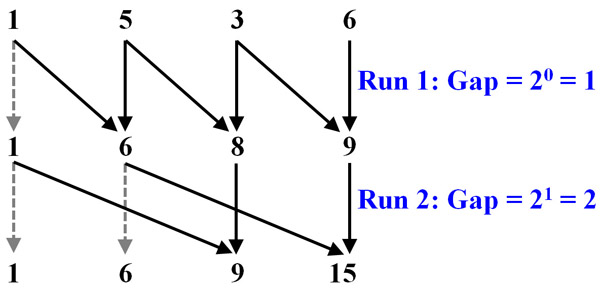
Consider a sequence of four integers: 1, 5, 3 and 6. In this case, we have n = 4 = 22 (i.e., n = 4 and k = 2). For four numbers (n = 4), it takes 2 (k = 2) runs to complete the work. The first run calculates the sum of two adjacent numbers (i.e., the gap between two numbers being 20 = 1). Thus, the resulting sequence is 1, 6 = 1+5, 8=5+3, 9=3+6. The second run calculates the sum of two numbers that are 2 positions away (i.e., gap = 21). From the result of the first run 1, 6, 8, 9, the result of the second run is 1 (copied), 6 (copied), 9=1+8, 15=9+6. The following is a diagram showing the computation process. This diagram uses solid arrows to indicate the additions and light color arrows for copying.
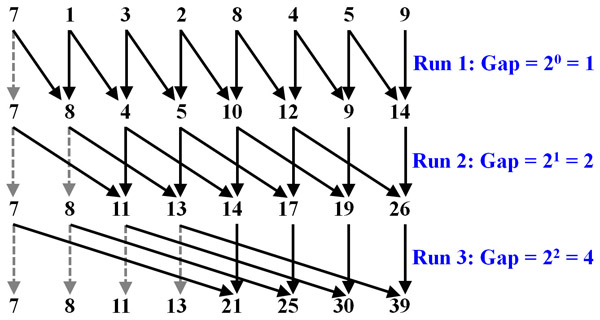
Now consider a sequence of 8 numbers: 7, 1, 3, 2, 8, 4, 5, 9 (i.e., n = 8 and k = log2(8) = 3). This takes three runs to complete the prefix sum. The gaps are 1 = 20 for the first run, 2 = 21 for the second run, and 4 = 22 for the third run. For the first run, we use the adjacent elements, yielding 7, 8=7+1, 4=1+3, 5=3+2, 10=2+8, 12=8+4, 9=4+5, 14=5+9. For the second run, the gap is 2 = 21 and we have 7 (copied), 8 (copied), 11=7+4, 13=8+5, 14=4+10, 17=5+12, 19=10+9, 26=12+14. For the third run, the gap is 4 = 22 and the final result is 7 (copied), 8 (copied), 11 (copied), 13 (copied), 21=7+14, 25=8+17, 30=11+19, 39=13+26. The diagram below shows the details of this process
In general, if we have n = 2k numbers, k runs are needed to complete the prefix sum computation. The following is a possible sequential algorithm:
for (stage = 1, gap = 1; stage <= k; stage++, gap *= 2) {
     for (i = 0; i < n-1; i++) {
          if (i - gap < 0)
               x[i] = x[i];
          else
               x[i] += x[i-gap];
     }
}
Note that the inner loop has some copy operations
which can be eliminated completely as shown below:
for (stage = 1, gap = 1; stage <= k; stage++, gap *= 2) {
     for (i = gap; i < n-1; i++) {
          x[i] += x[i-gap];
     }
}
How many additions are there in the above algorithm?
Note that run 1 uses gap 1 = 20,
run 2 uses gap 2 = 21,
run 3 uses gap 4 = 22, etc.
In general, run h uses gap 2h-1.
Moreover, if the gap is 2h-1,
then the first 2h-1 elements in the array are not used,
and the number of additions is n - 2h-1.
Because there are k runs in total, where n = 2k,
the total number of additions used is
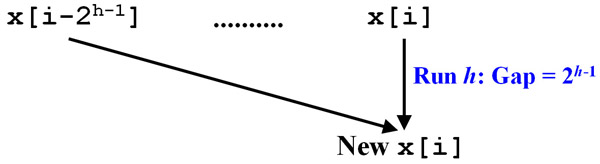
For run h, we need to execute n-2h-1 additions, one addition per pair of elements that are 2h away. Then, why don't we assign a CPU/thread for each pair? This is exactly what we should do. We could create n threads T0, T1, T2, ...., Tn-1. Thread Ti computes the value of xi + xi-2h-1 for run h. This is shown in the diagram below:
Can the new value of xi be stored back to xi? The answer is NO! (Why?) To overcome this problem, we need another array to store the intermediate results. The array to be used is a 2-dimensional one of k+1 rows and n columns, where k = log2(n): B[k,n]. Initially, we have the input elements stored in row 0 of B[0,*] (i.e., B[0,i] = xi for i = 0, 1, 2, 3, ..., n-1). Then, in run h, n threads T0, T1, T2, ...., Tn-1 are created so that thread Ti computes xi + xi - 2h-1, stores the result in B[h,i], and exits. In this way, the last row of B[k,*] contains the prefix sum results, where k = log2(n) is the number of needed runs.
From the above, we are able to quickly develop an algorithm to do a concurrent prefix sum computation. It is summarized as follows:
Here are a few notes:
The input file has the following format, where n is an integer of form 2k for some integer k > 0, and x0, x1, ..., xn-1, are n integers. You may assume all input values are correct so that you do not have to do error checking../prog3 < input-filename
n
x0  x1  x2 ...  xn-1
Suppose the command line is
and the file in.txt has the following lines:./prog3 < in.txt
Click here for a copy of this file.8 7 1 3 2 8 4 5 9
Then, your program output should look like the following:
Concurrent Prefix Sum Computation                 // from main()

Number of input data = 8                          // from main()
Input array:                                      // from main()
   7   1   3   2   8   4   5   9                  // from main()
                                                  // each number occupies 4 positions
                                                  // there has to be k = log2(n) runs
                                                  // from main(), do it for each run
Run i:                                            // from main(), run i
     ..........
     Thread j Created                             // from thread j
     ..........
     Thread j computes x[j] + x[j-2^(i-1)]        // from thread j
                                                  // thread j fills in the values of
                                                  //     j and j-2^(i-1)
                                                  //     fill in the values of j and j-2^(i-1)
     Thread j copies x[j]                         // thread j copies if no computation needed
     ..........
     Thread j exits                               // thread j exits
     ..........
Result after run i:                               // from main()
  aa bb cc dd ee ff gg hh                         // from main()
                                                  // use the input array format

Final result after run k:                         // from main()
   7   8  11  13  21  25  30  39                  // from main()
                                                  // use the input array format
In the above sample output, the main() prints out the input and all intermediate result arrays. The main() iterates k = log2(n) times. Iteration i uses gap length 2i-1, where i = 1, 2, ..., k. Thus, the gaps are 1, 2, 4, 8, 16, ..., log2(n)-1. All lines printed by the main() starts on column 1, and each data value is printed with 4 positions.
In each iteration, main() creates n threads, each of which does the following: (1) prints a message indicates that it has been created, (2) prints the two entries this threads has to add (e.g., x[5]+x[3] for run 2), and (3) terminates. All output from a thread starts on column 6.
This procedure may be repeated a number of times with different input files to see if your program works correctly.make <-- make your program ./prog3 < in.txt <-- test your program
// -----------------------------------------------------------
// NAME : John Smith                         User ID: xxxxxxxx
// DUE DATE : mm/dd/yyyy
// PROGRAM ASSIGNMENT #
// FILE NAME : xxxx.yyyy.zzzz (your unix file name)
// PROGRAM PURPOSE :
//    A couple of lines describing your program briefly
// -----------------------------------------------------------
Here, User ID is the one you use to login. It is not your social security number nor your M number.
For each function in your program, include a simple description like this:
// -----------------------------------------------------------
// FUNCTION  xxyyzz : (function name)
//     the purpose of this function
// PARAMETER USAGE :
//    a list of all parameters and their meaning
// FUNCTION CALLED :
//    a list of functions that are called by this one
// -----------------------------------------------------------
You should elaborate your answer and provide details. When answering the above questions, make sure each answer starts with a new line and have the question number (e.g., Question X:) clearly shown. Separate two answers with a blank line.
Note that the file name has to be README rather than readme or Readme. Note also that there is no filename extension, which means filename such as README.TXT is NOT acceptable.
README must be a plain text file. We do not accept files produced by any word processor. Moreover, watch for very long lines. More precisely, limit the length of each line to no more than 80 characters with the Return/Enter key for line separation. Missing this file, submitting non-text file, file with long lines, or providing incorrect and/or vague answers will cost you many points. Suggestion: Use a Unix text editor to prepare your README rather than a word processor.