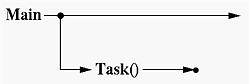
- If thr_join() is reached before the completion of the indicated thread, the caller waits until the completion of the indicated thread. After this, the caller executes its next statement.
- If thr_join() is reached after the completion of the indicated thread, nothing will happen to the caller and the caller executes its next statement.
#include  <thread.h>

void  Task(void *Junk)
{
     .......
     thr_exit(NULL);
}

void  main(void)
{
     thread_t   TaskID;
     size_t     TaskStatus;

     thr_create(NULL,0,Task,(void *) NULL,0,&TaskID);
     ......
     thr_join(TaskID, 0, (void *) &TaskStatus);
}
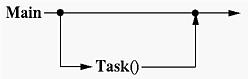
If thr_join() in the main program is reached before
Task() terminates, the main program waits there until
Task() completes. Then, the execution of main resumes.
This is illustrated by the following diagram:
On the other hand, if Task() has already terminated when the main program reaches thr_join(), there is nothing to ``join'' and the main program proceeds: